








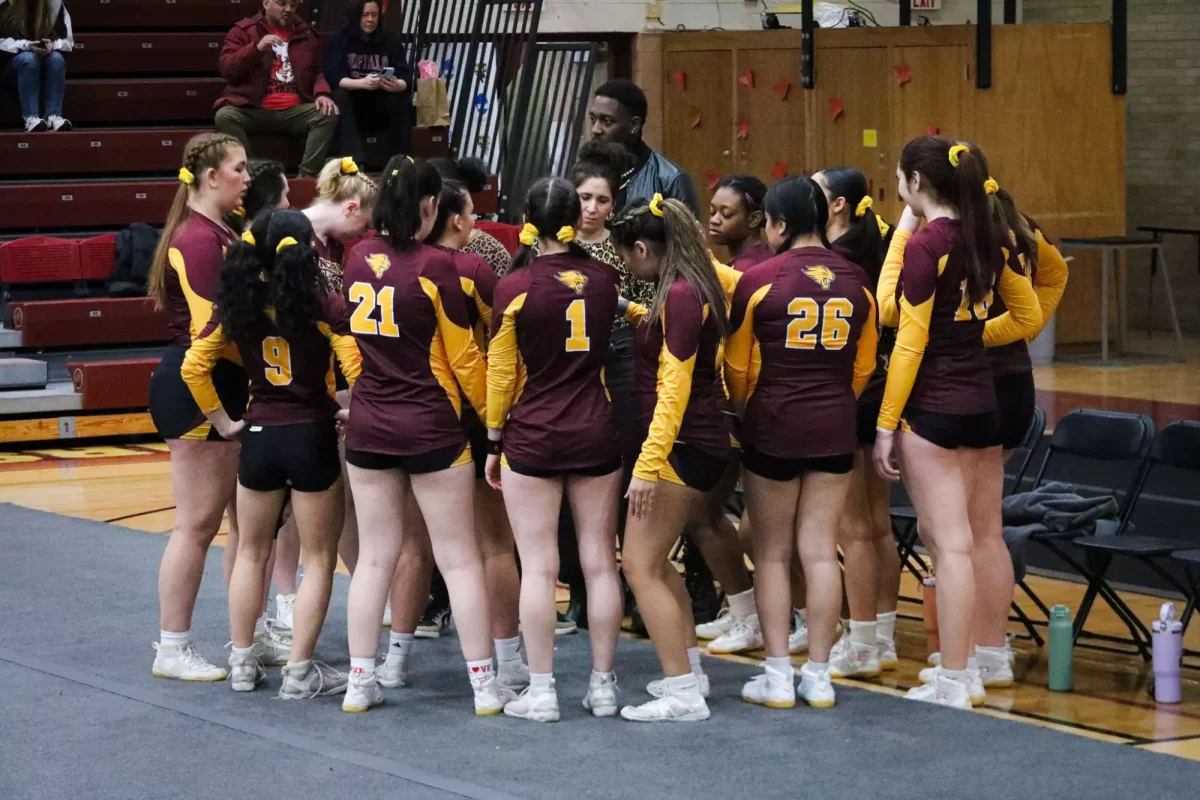





Amid allegations of athletes being pressured to compete through injuries and coaches not being present at practice, the Concordia University Chicago Cheer and Stunt teams had their 2026 seasons cancelled as questions began to appear pertaining to the culture of both teams.
In recent years, the Concordia University Chicago cheer and stunt teams have been two of the most successful programs at CUC. In their 2025 season, the cheer team made their second consecutive appearance in the Advanced All-Girl Division Three National Finals, finishing fifth in the country. The Stunt team also reached the National Championships in their sport before falling to Misericordia University, who was ranked second in the nation.
On Feb. 11, CUC director of athletics John Jaramillo put out a statement announcing the cancellation of the season. That same day, it was announced that Eleese “Cheetah” Farrar would no longer be serving as the head coach of either program.
Jaramillo said issues within the program were first brought to his attention late during the fall semester. That was when he began having conversations with Farrar. When the decision was made in early February that both seasons would be cancelled, Jaramillo spoke with the athletes before it was publicly announced.
“I told them personally,” Jaramillo said. “I didn’t want them to guess. I asked them questions about their experiences, and asked them what I could do to address anything. Around the same time is when the athletes heard from me that Coach Farrar was no longer with CUC.”
Jaramillo declined to comment on the factors that led to CUC parting ways with Farrar, and on when that particular decision was made, citing private personnel matters.
Athletes from both the cheer and stunt teams said they had been pressured to compete through injuries.
“During practice, I developed chest pains,” said Hyriany Borjas, a sophomore on the cheer team. “We were mandated to go to a tumbling gym, and when I went there I got yelled at. During conditioning, I tried to stop because of the pain, and I was yelled at for being a wimp.”
Georgia Lopez, a sophomore on the stunt team, also said that she was told to keep practicing through an injury, which has resulted in her now needing surgery.
“I had a recurring injury from freshman year, so I took the summer off,” Lopez said. “Coach Farrar did not take care of her athletes. If you got injured, you had to keep going. I injured my rotator cuff, and then my labrum.”
Farrar did not respond to questions for this article.
Another large issue surrounding the teams was the low number of athletes that each team had, and confusion over who was on each team.
“In October, an injury was reported, and the athlete participating wasn’t on the roster,” said Alex Sikora, the assistant athletic trainer. “We are liable for athletes; we’re the first to respond to an injury. If we don’t know they exist, we can’t contact them. It started with one, and there were more after that.”
Beyond documentation issues, the low number of eligible athletes on each team forced higher-level athletes to practice routines with athletes that weren’t up to the same skill level.
“We had athletes that were at a level five skill level, and they had to practice with athletes that were only level one or two,” Sikora said.
The number of eligible athletes on each team played a role in Jaramillo’s decision to cancel both of the seasons.
“As the fall semester was nearing its conclusion, we looked at the number of eligible students on each roster,” Jaramillo said. “We looked at where we are at with the rosters, and shortly after the spring semester began, we asked ourselves the question of whether we would have enough to field a team.”
Low recruiting numbers were unsurprising to the athletes on the team.
“Recruiting was terrible,” Lopez said. “I don’t think any of it was done by the coaches, it was all done by the captains on the team.”
One aspect that didn’t help was the question of Farrar’s commitment to the team.
“There was a lack of accountability with the coaching staff,” Lopez said. “Coaches didn’t show up as often as they should. It was a terrible environment.”
Borjas agreed with Lopez, saying that it felt like the coaches had been more committed the prior season, and that coaches wouldn’t show up on time to practice, so the athletes would have to wait for them.
It wasn’t just the athletes that noticed a lack of commitment from the coaches. Sikora said that she felt the athletes were being put on the back burner.
“I feel bad for the athletes,” Sikora said. “You need a coach that is present. In December, I began expressing my concerns about what everything would look like when we returned from winter break. Then we came back from break and there were two straight weeks of miscommunication and coaches not being present.”
Sikora said she tried to have conversations with Farrar on multiple occasions, but Farrar wouldn’t communicate with her. Sikora said there were times when she would try to communicate with Farrar about the team, and get no acknowledgement of her concerns.
Both Lopez and Borjas said they were not surprised by the announcement that their respective seasons had been cancelled.
“Compared to where we were last year, we had nothing,” Lopez said. “There was no way we could have had a season.”
Jaramillo has already begun the process of finding someone to replace Farrar, and knows what he is looking for in a coach.
“We want someone that is consistent, and has strong, caring, and empathetic leadership,” Jaramillo said. “The Chicagoland area has a strong pool of talent for both athletes and coaches, and CUC has a lot to offer.”
Jaramillo added that while there is no firm timetable for hiring a new coach, he would like to have someone hired by the end of the semester, so that they would be able to meet with current and incoming student athletes.
“It’s not easy to do a coaching search during the school year, but there really is no good time,” Jaramillo said.
Sikora said that while she is sad for the athletes that won’t to compete this season, cancelling the seasons was the right call.
“I feel bad the athletes won’t get a season, but it takes a weight off their shoulders,” Sikora said. “I’m relieved they won’t be put in positions where they aren’t prepared. College is tough, we don’t need to make it tougher for the athletes.”
Sikora also has specific traits in mind for any prospective cheer coach.
“We need someone that will take the time to know and understand their athletes,” Sikora said. “That’s what makes the difference between a team staying together, and a team falling apart.”