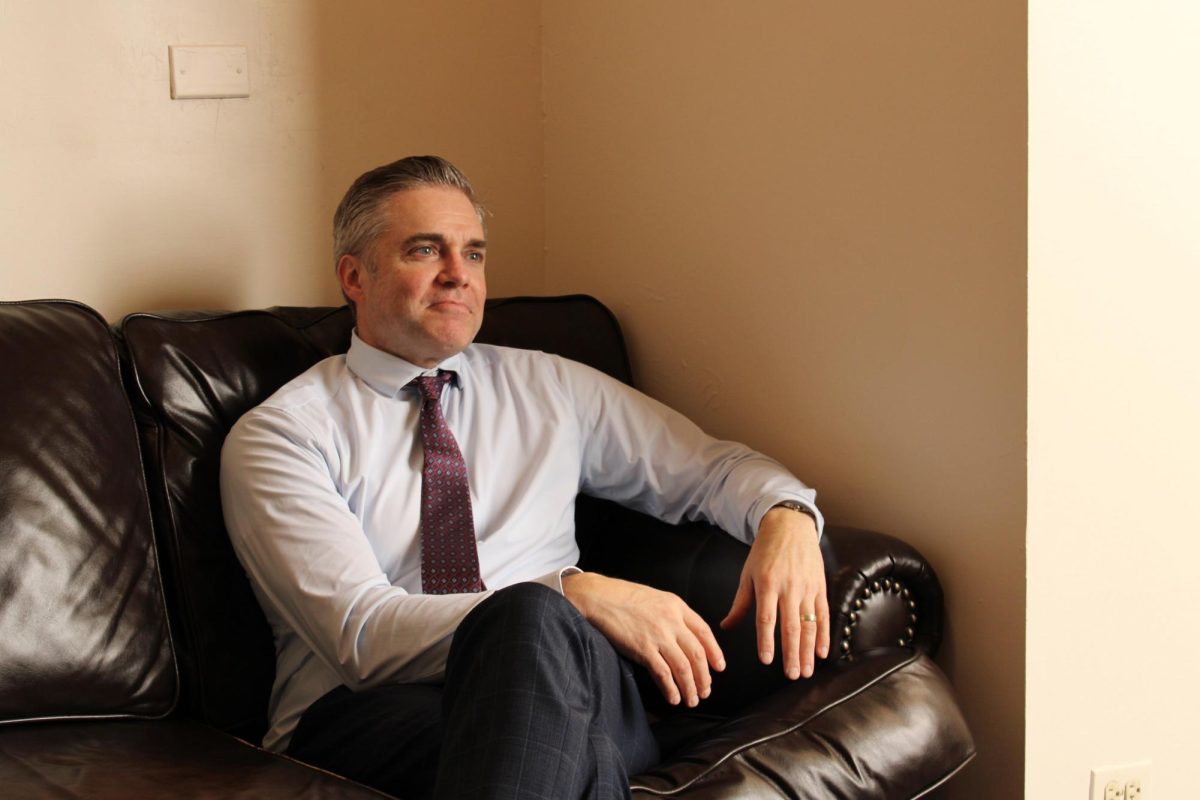










As professor of theology Charles Schulz stood in the middle of Concordia University Ann Arbor’s Zimmerman Library, which was deserted save for his five-person crew and the librarian, he felt all of the memories come flooding back. He recalled long nights completing schoolwork for his undergraduate degree and doctorate, and remembered holding classes in some of the rooms in the library, directing students to particular resources.
Now the Zimmerman Library’s future is uncertain. With CUAA ceasing the majority of its programs in June 2025 and currently in talks to sell off most of its land, Schulz stepped into its library for perhaps the last time to rescue books for CUC’s collection.
“It was bittersweet,” said Schulz, who had come to teach at CUC in 2024 after CUAA had first announced their restructuring. “That library had been my undergraduate library. I went to school there, and I taught there for about 23 years. And now to see the campus silent and empty is heartbreaking, because it was such a vibrant ministry in that place.”
Early this semester, after many months of asking what would happen to the collection, Schulz was notified of the opportunity to recover books from the CUAA library. He then put out a general invitation to CUC faculty to select books from the library catalog that would be useful to them and their students.
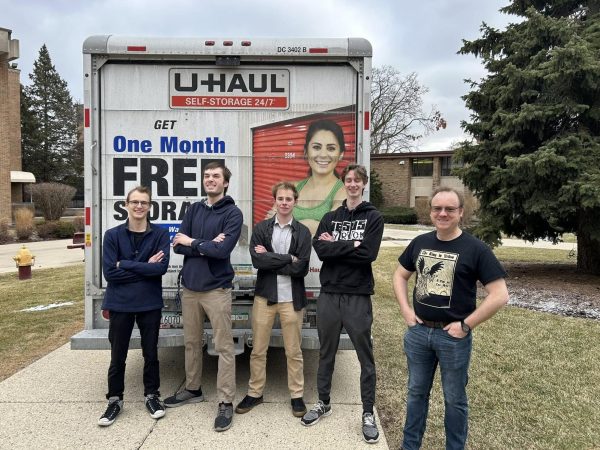
On Friday, Feb. 20, Schulz, along with four of his students and assistant professor of English Joshua Tuttle, embarked on a roadtrip to CUAA to bring books from their collection to CUC. The crew stayed in the home of Schulz’s former parishioners in Ann Arbor for the night and were at work in the CUAA library in the morning.
By the end of the experience, after painstakingly typing out every ISBN and barcode to document what they took, they loaded a U-Haul with approximately 2,000 books, most of which were related to English or theology.
Schulz wasn’t the only one on the road trip with a connection to CUAA. Junior Tim Burmann, one of the students helping out with the haul, was formerly a student there before transferring to CUC in 2024.
“I think it was a good experience,” Burmann said. “It kind of felt like burying the body a little bit. Like, all right, it’s over. But now we can at least take the good things that we knew were over there and bring them over to our collection,”
Though the crew walked away with boxes upon boxes of books, they still had to be selective about what they chose to take.
“It had to be something that I could see wanting to either use in a course or things that, in the way that I’m often directing students into the library to do some browsing and discovering on their own, things that they would, following a citation trail, be led to,” Tuttle said. “Basically, it had to be something that a student would be led to directly or indirectly from the coursework. Otherwise, I couldn’t justify it.”
The English literature is currently stored in the third floor of Brohm Hall, though where the books will ultimately land is still uncertain. Tuttle hosted a book sorting party on March 31 to discover which books from CUAA are already owned by the CUC library, in order to prevent duplicates in the collection.
“This really was probably a once-in-a-generation opportunity to grow our collection in one fell swoop at zero cost,” Tuttle said.
The theology books are now housed in the St. Isidore of Seville Theological Collection, found in the second floor of Kretzmann Hall.
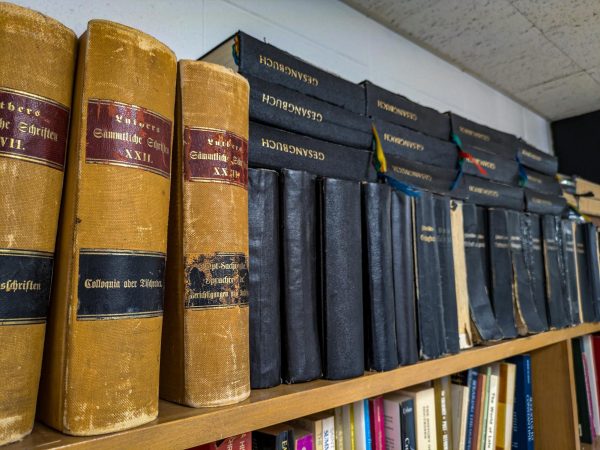
“I know some of my colleagues have already found it useful, when I’m preparing for a class and I say, ‘I need a commentary on that Bible book’ and I don’t happen to have one on my shelf,” Schulz said. “It’s very convenient for me and my studies and supporting my work with the students. And I’ve already had the parents of prospective students comment on how impressive the books look and how it indicates that our school is a place for study and for real intellectual growth.”
The theological library is open to all students. Students can check out books by emailing Schulz with which materials they have taken out.
“It’s very helpful, especially for languages. We have a bunch of patristic church fathers in original languages, so a bunch of Greek and Latin and church fathers, so that’ll be a super good resource,” said junior Troy Zimmerman, one of the students who went on the book haul trip.
The newly-acquired books have wider relevance beyond church work and theology students, extending to other fields relating to the humanities.
“Those books that we got, there’s no way to really describe how useful those things are for the students that we have, especially in any sort of classics-type department like English, theology, philology, philosophy,” Burmann said. “We don’t have those books here. And so being able to have those and have them at free access, it’s just insanely useful for us.”
Despite the sadness surrounding the closure of CUAA, Schulz viewed the experience as an opportunity to expand CUC’s holdings of physical books, a fleeting resource in an increasingly digital world.
“Students are drawn into deeper scholarship when they have a physical book in front of them. Even when it’s on the shelves, it invites them to open it in a way that a web page doesn’t,” Schulz said. “And not only does the book on the shelf invite you, but the book next to it, and the book that you just happen to be passing by, and so the serendipitous discoveries that happen with library collections are just untold. They’re just fantastic.”
Correction: A previous version of this article incorrectly reported that the English books would be integrated into the collection at Klinck Memorial Library. They will not be absorbed into the library’s collection.