

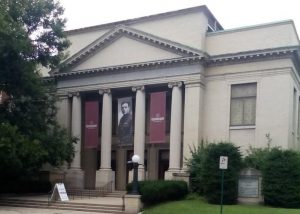
The grand building at 200 North Oak Park Avenue was originally constructed for The First Church of Christ Scientist. The tall room housing the Hemingway Museum is flooded with natural light, the perfect setting for the story of a writer who loved the outdoors.
Upon entrance visitors are welcomed by Conni Irwin, the “Official Greeter.” She has been with the museum for 25 years in various capacities. Irwin confessed she loves to talk to visitors and her warmth and humor make listening a pleasure. Before heading into the display, be sure to ask Irwin for her favorite Hemingway story. She will regale you with tales of Hemingway’s war years and bawdy adventures.
The museum itself is only about 2000 square feet, but it is cleverly laid out for both Hemingway worshipers and those who are just casual fans.
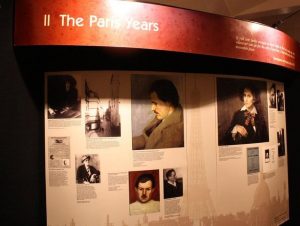
The center of the exhibit consists of a circular set of panels offering a brief overview of Hemingway’s life. From his birth and childhood in Oak Park, to his later years. Each panel represents a different important chapter. During his time at Oak Park River Forest High he began his journalism career writing for the school paper the Trapese and Tabula. The next panel has information about his first professional writing position with the Kansas City Star, secured for him by his uncle, Tyler Hemingway. This is followed by his service in WWI, where he volunteered as an ambulance driver after failing the military medical exam. The WWI panel concentrates on a “Dear John” letter from Agnes von Kurowsky, the letter begins “Ernie, dear boy.” Kurowshy was an American nurse he met while being treated for shrapnel wounds during the war. Irwin’s version of this story is much better than what you’ll read on the panel, she adds the karma Kurowshy encountered later in life when she was engaged to a wealthy Italian gentleman. The panels continue with Hemingway’s time in the Spanish revolution, on to WWII, his travels after the war, his wives and children, and his later years.
Other exhibits cover each period in Hemingway’s life in greater depth. A particularly interesting exhibit has hand written samples of early drafts of stories. These drafts show notes he used for his numerous rewrites and give the viewer and insight into his method for crafting his stories. Some of these also include the names of real people which he scratched out, they would later be replaced by pseudonyms.
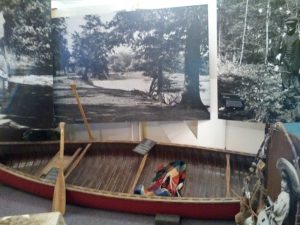
There are two videos playing on continuous loop. The first screen shows a short documentary of about seven minutes about Hemingway’s life in Oak Park, it was made by the Oak Park high school teacher who began the Ernest Hemingway Foundation of Oak Park. The second video screen plays an interview with one of Hemingway’s sisters, and includes pictures of her Michigan home. Vacations in Michigan were an important part of Hemingway’s childhood, playing an integral role in his later love of nature and the outdoors. There is a display that goes into this period in depth.
Allan Baldwin, the treasurer of the Hemingway Foundation, pointed out the museum actually has three parts, the museum, Hemingway’s birth home and an archive at the Oak Park public library. The archive can be accessed on line thanks to a grant from the Illinois History – Digital Imaging Grant Program. The foundation was established in 1983, “the mission of the organization…is to focus on the years he lived in Oak Park. He lived in Oak Park for about a third of his life, until about nineteen. So, most people would say the most critical time for development” said Baldwin.
Baldwin is quite proud Hemingway was an Oak Parker, and explained Hemingway’s famous quote, “Oak Park is a village of broad lawns and narrow minds” has never been verified. Baldwin continued, “He didn’t write about Oak Park at all. Some people look at that as protecting, because you never wanted to be written about by Hemingway. You would end up in bad shape one way or another.” Hemingway also rarely visited Oak Park after moving away. Baldwin opined this was most likely due to the tense relationship Hemingway had with his mother. This becomes clear in letters left behind by the prolific writer. There is a collection of about 6,000 letters written by Hemingway, they are currently being compiled for publication.
The price of admission to the museum includes a tour of Hemingway’s birthplace home, just a short walk from the museum. The birthplace home is a beautiful three story Queen Anne built in 1890. Tours of the home start on the hour and show off the building itself as well as family photo’s, memorabilia and some of Hemingway’s early writing, there is also a gift shop in the home. The Hemingways lived in the birthplace home until Ernest was about six years old and then moved to a home a few blocks away. The second home was at one time owned by the foundation, but is now in private hands.
The museum, birth home and library are about a half mile from the CUC campus, an easy walk for an interesting experience.
