



















“It’s going to happen again.” The viral audio clip from the TV show Dexter plays over a series of videos depicting an unseen individual pretending to publicly urinate at various locations across campus.
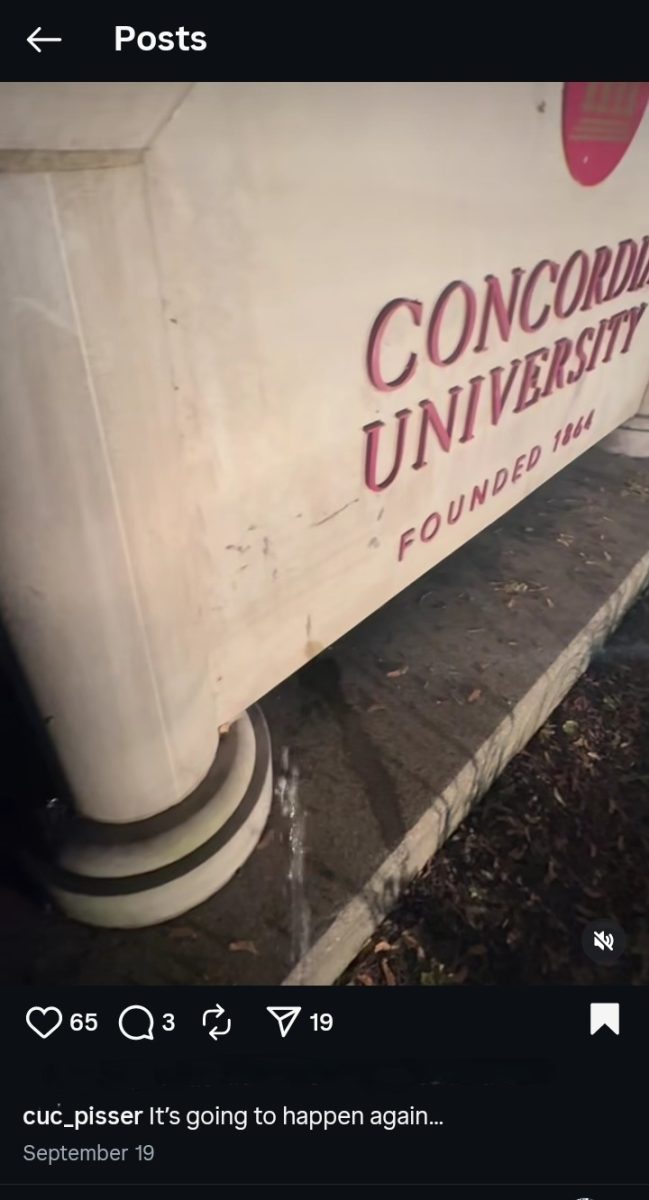
The perpetrator, @cuc_pisser on Instagram, posted their first video on September 19, using a water bottle to pretend to urinate at the Concordia University sign at the corner of Augusta and Bonnie Brae. They later struck four other locations, and their account is now deleted.
The prank is part of a larger trend nationwide of anonymous individuals taking viral videos of themselves pretending to urinate on various landmarks across their college campuses. In Illinois alone, students at Illinois State University, University of Illinois Urbana-Champaign, Southern Illinois University and Millikin University have participated the trend. Among the universities impacted outside of Illinois were Commonwealth University-Bloomsburg, Florida Atlantic University, Syracuse University and Ohio State University. The individual behind the prank videos at CUC says that they were also inspired by this trend, wanting to put their own spin on it.
“I like content creating and I saw this as an opportunity to do that,” the owner of the account, who wished to remain anonymous for fear of disciplinary action, stated over an Instagram message. “I promise that the campus is only getting hydrated, not violated.”
One student decided to take matters into their own hands, donning a vigilante persona and posting content themselves under the handle @cuc_pisser_hunter. The account, which posted pictures of Batman and vowed to discover the identity of the “CUC pisser,” catapulted themselves and the individual behind the public urination stunts into a cat-and-mouse game that culminated in an encounter along Augusta that was filmed by both parties.
“The content was a joke, clearly water and not urine was involved, and it appears to be pure entertainment meant to become an urban legend of CUC,” said the owner of the @cuc_pisser_hunter account, who also wished to remain anonymous, fearing further penalties from administration. They added that the creation of their account was intended “to throw chaos into the mix and entertain others and myself.”
On October 2, just a day after the dramatic encounter, both accounts were taken down after disciplinary action was taken by Residence Life. Prior to the prankster’s apprehension, they had filmed videos of the sign at the corner of Augusta and Bonnie Brae, a restricted rooftop, the David-Jonathan parking lot, and the outskirts of the athletic fields. Residence Life, the Department of Public Safety and Dean of Students Kathy Gebhardt have declined to comment on the matter.
CUC’s Social Media Policy allows for the authority of the university to review content posted on social media, especially if the content is in violation of a listed policy. The policy prohibits content that breaches the Honor Code or Student Code of Conduct, but also extends to content that is “hateful or embarrassing to any person or entity.”
Mike Hiestand, legal counsel at the Student Press Law Center told The Spectator that “a private university generally has broad authority to regulate student expression—including social media—unless it has voluntarily limited that authority through its own policies, contracts, or promises of expressive freedom.”
Before the Instagram accounts were removed, the activities garnered much attention on campus, spurring a wide range of theories and reactions.
“I’m terrified,” freshman Mason Moffitt said. “What’s next? One minute it’s outside, one minute it’s on buildings, fields, monuments. Next it could be on Martin Luther.”
Other students tried to play detective, attempting to uncover the identity of the individual responsible.
“Ever since I saw the video of the CUC pisser at the sign, that’s when I was just analyzing people and seeing who’s the traitor,” said freshman Wesley Greco. “It could be anybody.”
Junior David Young was shocked at first by the videos, before realizing that they were fake.
“It was a fun story to follow because there were heroes and villains,” Young said. “And it’s kind of a fun part of campus lore, but there are other ways to do it without making the claim that you’re committing a crime on campus property.”
It is still unclear what the exact reason was for the suspension of both accounts, or how the identities of both individuals were discovered by administration. However, some students believe that it was the repeated nature of the act that helped contribute to their discovery.
“If he had stopped after two or three [times] he wouldn’t have gotten caught and I think that’s super interesting,” Young said. “But he continued to do this against all reason. He was like pee-Icarus and he flew too close to the sun.”