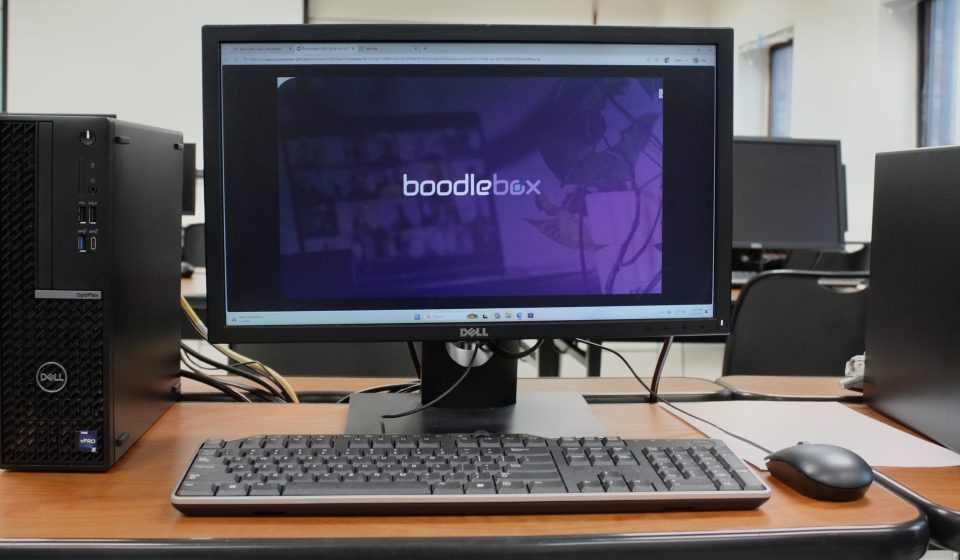

At the start of the fall semester, students at Concordia University Chicago were informed that they would have access to a new tool to help with their learning: Boodlebox. Boodlebox is an AI workspace that gives students access to 38 different AI “models,” such as Claude, GPT, Gemini, and more.
While discussions about CUC software to help students have been taking place over the last few years, the decision to purchase Boodlebox wasn’t finalized until after Vice President of Academic Affairs Robert Balza arrived in River Forest in January. Balza previously served as the Chair of the AI Taskforce at Concordia University Wisconsin.
The final price for Boodlebox was negotiated by CFO John Thoelke, who declined to disclose the final price tag the school paid for the software. Balza said he knew the payments would be spread out over multiple years.
With Boodlebox, Balza has four different distinct goals in mind. “We want to make a governance plan, we want to provide professional development, we want to develop academic programming such as majors and minors, and we want to do this all in an ethical, transparent way,” said Balza.
Boodlebox was chosen specifically because it gives students access to a wide variety of AI chatbots. “We have a social contract with the students to give them all the tools they need,” said Balza. “We want to encourage students to use all the tools they can.”
This sentiment was shared by Dr. Alicia Hernandez Grande, the Director of Instructional Design and Technology here at CUC. “You’re not on an equal playing field if some students can afford Chat GPT Premium and others can’t,” said Hernandez Grande.
Balza has ideas for how students will be able to use Boodlebox to help with their classes. “It can help with brainstorming or proofreading purposes,” said Balza. “If they are giving presentations, it can help with generating images for those presentations.”
Boodlebox can also be used by faculty as well. “It allows faculty to create tools that students can have access to,” said Hernandez Grande. “Faculty can use it to create their own bots to help with upcoming tests or quizzes, such as putting in practice questions. It can also tell faculty how difficult an assignment for students will be.”
Despite being a tool that students and faculty will be able to use, Hernandez Grande emphasized that Boodlebox will not be replacing Blackboard, the learning management system that CUC professors use to assign homework and post important class information. Rather, Boodlebox will help supplement Blackboard. Hernandez Grande said Boodlebox will not be used to grade assignments, and that will all still be done by the teachers themselves.
With the introduction of Boodlebox also comes the introduction of an AI taskforce at CUC. Balza said that the AI taskforce is made up of a mixture of staff and faculty members, and includes one person that he described as a “conscientious objector.”
“The goal of the taskforce is to improve how CUC as a whole responds to AI,” said Hernandez Grande. “We know we have Boodlebox coming. How can we get faculty trained on it? How can we as a university provide improved guidelines?”
Last fall, the school sent out an anonymous survey asking students how often they used AI for help with schooling. While the full results of the survey have not been made publicly available, Hernandez Grande did say what the survey found.
“Our student survey showed that, for academic purposes, 35% of those surveyed stated they used Gen AI regularly, 43% used it occasionally, and 22% state they never used it,” said Hernandez Grande.
While Balza and Hernandez Grande are enthusiastic and optimistic about the opportunities that Boodlebox will provide CUC students, others are less excited about it. When the school announced the purchase of Boodlebox software via an Instagram post in late May, the comments, which came from a mix of both current and former students, were overwhelmingly negative.
As a result, the CUC Instagram account responded to the negative messages. “We’re seeing the feedback on this announcement,” the comment said. “This initiative is focused on helping students use AI responsibly, with faculty determining how and when it is used in their courses. Academic integrity standards remain unchanged.”
The comments to that comment remained unenthusiastic. One account replied, “Respectfully, there’s absolutely no genuine need for students or faculty to use AI. As a current student, I don’t see any benefit to the university. I don’t want to use AI in any of my courses AT ALL and I’m sure many students would agree. I would urge you to reconsider and at least hear what the students have to say.”
It is not just some of the students that are skeptical about the purchase of Boodlebox. Brian Sundermeier, Professor of Psychology, has his concerns about Boodlebox and generative AI as a whole.
“You think you’re getting a leg up, but you’re putting yourself at a disadvantage,” said Sundermeier. “It may give students a better grade, but will it enhance their skills and development? I know how these models work. They are programs that do not reason, think, or interact with the real world. Any seeming problem solving or thinking that may come out of this is a prediction of what the next word will be. I don’t see how that helps students think.”
One concern that Sundermeier had was the ethics of using generative AI as a Christian. “I’m shocked that as a Christian institution we have not had deeper conversations about using this technology,” said Sundermier.
Sundermeier cited the psychological impacts on the humans who are exposed to all kinds of harmful material as they filter the content that goes into generative AI. “Who is doing the human labor?” said Sundermeier. “Who is tagging the items? They have to be filtered for porn and abuse. These individuals are in front of abusive and violent materials for hour after hour, day after day. Who is caring for them?”
In an article for Zevo Health, Dr. Michelle Teo said, “While AI efficiently handles repetitive tasks at scale, it often struggles with context, pushing the most disturbing and complex cases to human reviewers. In AI-driven environments, Content Moderators are frequently exposed to harmful material, including violent, explicit, and abusive content.”
Another concern Sundermeier voiced was the question of privacy and copyright. Since generative AI uses pre-existing texts and media to learn and better shape its answers, that has created questions and lawsuits about whether or not AI learning from copyrighted material would count as copyright infringement.
“The texts come from authors that have not allowed use of their materials,” said Sundermeier. “They are artists, and we are stealing their art.”
When asked about the questions surrounding copyright infringement and AI use, Balza said that he hoped the legal system would figure out that question.
As for the other concerns that both students and faculty had about AI, Balza compared it to backlash that different forms of technology have received in the past. “This type of controversy has always existed,” said Balza. “In the 1980s, teachers banned calculators. As a productive biochemist, I use calculators all the time. In the 1990s, you had the same thing with the Internet.”
Balza reiterated how he believes that CUC has a duty to give students AI training, since they will need it post-graduation. “It is very clear that employers are looking for AI skills,” said Balza. “We have an obligation to make sure students receive AI training, and our goal is to make sure that happens. If they don’t get AI training here, where will they get it?”
Balza also said that one reason Boodlebox was chosen is because it is easier on the environment that other generative AI services are.
“The environmental impact of AI is real,” said Balza. “As Christians, we have a duty to protect the environment. Boodlebox has things that drastically reduce its environmental impact. It has token-reduction technology built-in, which means that it uses less tokens for each response, and therefore has less of an impact on the environment.”
In generative AI, a token is a unit of data that a generative AI platform uses to help compose its answer. On their website, Boodlebox says, “our token savings are equivalent to conserving enough energy to power over 500 homes for an entire year.”
The question of whether or not Concordia should be teaching its students how to use AI is one that will undoubtedly be discussed heavily by both students and faculty going forward. But Balza believes that the school is taking the right steps with the purchase of Boodlebox for students and faculty.
“AI is here to stay,” said Balza. “We need to learn to live with it.”
Photo by Clara Brown.