

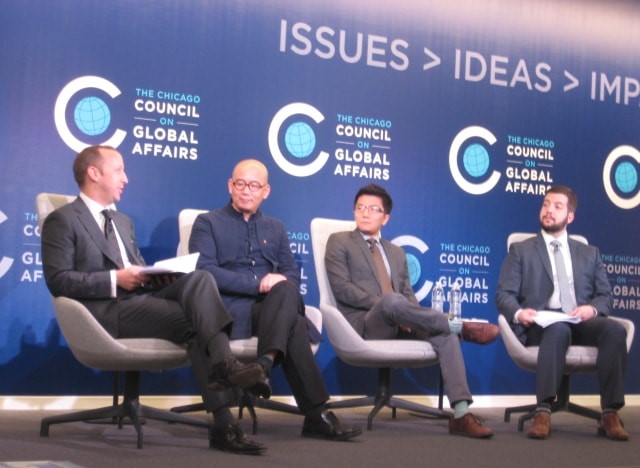
 The Chicago Council on Global Affairs held another interesting and informative symposium covering public opinion in China and comparing Chinese opinions with those in the U. S. The presentation was moderated by Karl Friedhoff with Craig Kafura, Damien Ma and Dr. Victor Yuan speaking. The discussion centered on a series of public opinion surveys, by Yuan’s company Dataway, featured in the report Views from the G2: Public Opinion in the US & China.
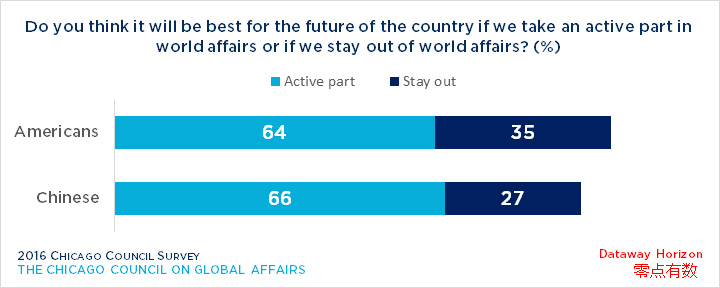
The views of the two countries are surprisingly similar in many areas. Such as when respondents were asked if their countries should take an active role in world affairs.
Victor Yuan pointed out the Chinese would like to see their country become more involved with peace keeping missions. When asked if the Chinese media kept the people informed of the casualties Chinese peace keeping troops were suffering as of late, Yuan responded that the state media is forced to report the casualties because so many in China are active in social media. News is collected on the internet and shared through social media, this forces state run media to report the truth or lose credibility. Yuan went on to point out, he, like many in China, get the majority of their news through social media.
Karl Freidhoff asked Damien Ma to comment on future U. S. policy in Asia. Ma began by pointing to the forty year stable relationship China and the U. S. have shared. The main pillar of the relationship is trade. He went on to explain the relationship may be in trouble following the recent U. S. presidential election. President Elect Donald Trump has no clear Asian policy and has expressed anti-trade and anti-globalization sentiments during the campaign. If the main pillar of our relationship is undermined there is no telling the direction of U. S. / China relations. Craig Kafura noted future U. S. actions are speculation; it is too soon to know the policies of the incoming administration. Yuan added that many in China are optimistic. Both Hillary Clinton and Donald Trump came out against the Trans-Pacific Partnership during the campaign. But, Trump is a businessman and many business leaders in China believe they will be able to work with him.
Two survey questions exposed some large differences in the opinions of Americans verses Chinese. The first was do you think your parents were economically better off or worse off than you are today.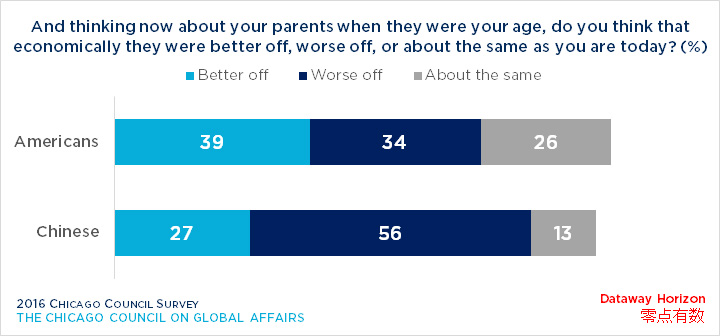
The second asked if today’s children will be economically better off or worse off than adults are today.
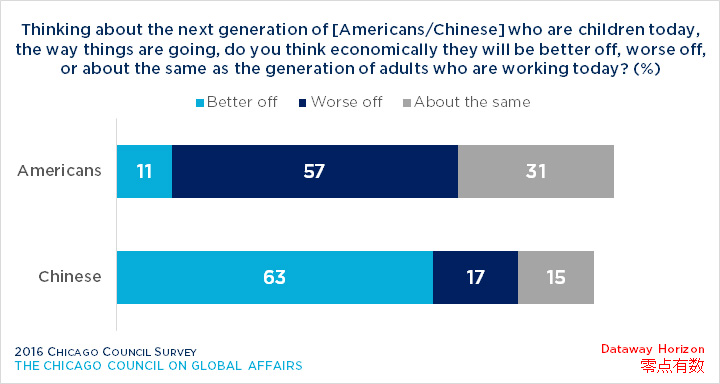
Both of these show the Chinese public is far more optimistic about the future than the American public. This coincides with many of the explanations for the outcome of our most recent election.
A recording of the full symposium can be seen here.
